Climate Change
Scientists say many plants don't respond to warming as thought
Plants, like people, breathe, and when it gets hotter, they breathe harder. One product of respiration is the greenhouse gas carbon dioxide. Thus, researchers predict that as the planet is warmed by human-produced CO2, plants may add to the emissions, and amplify the warming. Now, the most comprehensive global study of its kind yet suggests that this effect has limits, and that increases in plant respiration may not be as big as previously estimated. It shows that rates of increase slow in an easily predictable way as temperatures mount, in every region of earth, from tropics to tundra. The newly defined curve leads to sharply reduced estimates of respiration, especially in the coldest regions.
On the most basic level, the study suggests that all plant life has the same internal temperature controls. It looks at respiration on daily to seasonal levels and does not directly address long-term climate change, but it does suggest that plant respiration may not feed back into global warming quite as much as feared. The study appears today in the Proceedings of the National Academy of Sciences.
"What we thought was a steep curve in some places is actually a little gentler," said coauthor Kevin Griffin, a plant physiologist at Columbia University's Lamont-Doherty Earth Observatory. "With this new model, we predict that some ecosystems are releasing a lot less CO2 through leaf respiration than we previously thought." The biggest changes in estimates are in the coldest regions, which recently have seen warming far beyond that in temperate zones. "All of this adds up to a significant amount of carbon, so we think it's worth paying attention to," said Griffin.
The cells of living creatures must respire in order to build tissues and carry out basic metabolic processes. Plants take in vast amounts of carbon from the air during photosynthesis, but they also breathe much of it out in respiration. Worldwide, plants are believed to respire about 60 billion tons of CO2 each year—about six times what humans produce through burning of fossil fuels. Scientists have long known that plants respire faster when it gets hotter, and there are some fears that if global temperatures get high enough, they will become less efficient, and respiration will outweigh photosynthesis, heightening CO2 in the air.
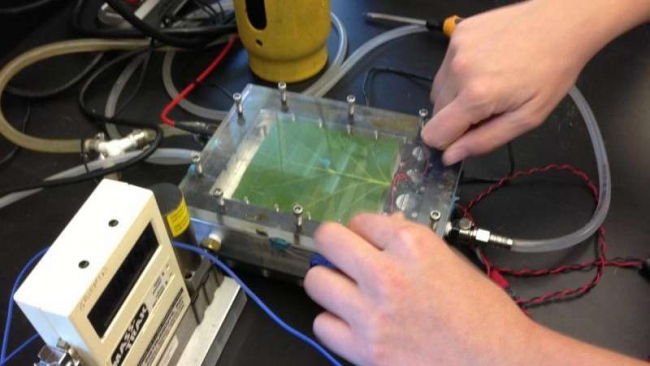
Up to now, climate models have assumed that as temperature doubles, so does plant respiration, whether on daily, seasonal or longer timeframes. The authors confirmed that short-term speedups with higher temperature take place everywhere—but that the rate of increase slows along a simple, predictable curve as temperatures mount. Setting up instruments in the field and subjecting leaves to rising temperatures over half-hour spans, they measured plant responses in 231 species, from herbs and grasses to shrubs and trees. Study areas included Alaskan tundra; boreal forests in Minnesota and Sweden; temperate forest in New York's Hudson Valley; tropical areas in Peru, Costa Rica and French Guiana; and savannahs in Texas and Australia. These far-flung regions have widely differing growing-season temperatures, ranging from a mean of 8 degrees C (42 F) in Alaska to 28 C (82 F) in parts of Australia.
Source: Phys.org
Tue 22 Mar 2016 at 07:57